Men's absence and women's labor burden
The PeasantsMen’s absence and women’s labor burden describes a material crisis in Lipce, where the removal or withdrawal of working men leaves women responsible for keeping households and farms alive. The pressure is most visible after the men are imprisoned following the forest conflict: spring arrives, the fields need ploughing and sowing, and the women left in the village must manage both agricultural work and the daily care on which family survival depends. The novel measures absence not only in empty fields, but in unfinished chores, failing buildings, hungry animals, and women’s exhausted bodies.
The household before the crisis
Men’s absence sharpens difficulties that already govern rural life. Before a winter fair, Lipce households must decide what to sell and how to pay taxes, commune contributions, debts, and servants. Even families with fifteen morgen of land struggle to find ready money; poorer households have still less room to maneuver. The pressure turns animals and harvest into urgent financial calculations: a cow may be cleaned and fed extra clover or boiled barley with potatoes so that she looks fuller for sale, while an old horse is made presentable enough to pass at market. These details establish the narrow margin on which household survival rests. When labor later disappears, it is not an otherwise secure economy that is disrupted, but one already vulnerable to seasonal expenses and scarcity.
The burden is also visible in Antek Boryna’s household after its expulsion from the paternal homestead. Hanka Borynowa nurses her younger child while describing weeks of quarrels and hardship. When Antek declines an offer of threshing work, the family has potatoes and salt but almost no money, and Hanka fears they will have to sell their cow. She thinks she would work without sparing herself if she could, but her position and responsibilities limit what she can do. The episode distinguishes physical willingness from access to work and decision-making: the household’s need is immediate, yet its survival depends on a husband who refuses hired labor.
The work left to women
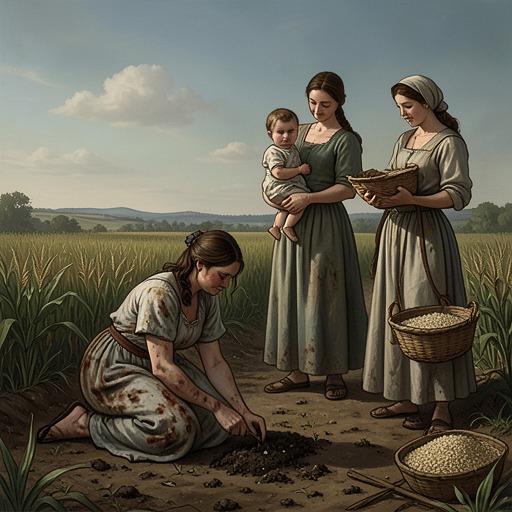
The imprisonment of Lipce’s men turns a chronic strain into a village-wide labor emergency. Spring requires ploughing, manuring, sowing, planting, draining water from fields, and sorting potatoes for planting. At the same time, cows calve, poultry hatch, and sows farrow. Women must also feed and water livestock, chop feed, split and cart wood, tend children, and maintain their homes. Some are pregnant, and the work is so extensive that the women cannot complete it all; by evening their backs are numb, while the crucial work in the fields remains undone.
The novel makes the mismatch between seasonal urgency and available labor stark. The earth is ready for cultivation, winter grain is growing, and birds and storks have returned, but Lipce’s fields remain empty. The surrounding countryside is active with ploughs, horses, carts, and people working, while the village’s agricultural cycle stalls because the able-bodied men are in jail. Women’s work does not simply replace the men’s tasks: the text emphasizes that they lack the strength and capacity to manage everything alongside their existing responsibilities. The result is fallow land and a growing threat to the next harvest.
Care, exhaustion, and village solidarity
The consequences reach beyond cultivation. As Rocho goes from cottage to cottage, he sees fences falling, thatch torn, gates broken, and houses leaning without repair. Stagnant water and deep mud impede movement; cows bellow from hunger, horses stand amid dung, calves wander untethered, and tools and ploughs decay in the rain. The women have barely enough strength and time for urgent work, much less for repairs. They wait for the imprisoned men’s return as if it were a deliverance, but no one can tell them when that return will come. Their labor is stretched across care, household maintenance, and farm production, while the village’s material environment deteriorates around them.
During the approach to Easter, women and girls alone are at liberty to work across the village. They hurry through domestic preparations, arrange for wheat to be ground, ready blessed food baskets, and consider what household goods or provisions can be sold to obtain necessary cash. Rocho recognizes the scale of the need but cannot sustain an entire village by himself. His efforts offer a measure of assistance, not a substitute for the absent labor force. The distinction matters: women’s work is indispensable, but neither their exertion nor individual acts of aid can fully repair a collective shortage of hands.
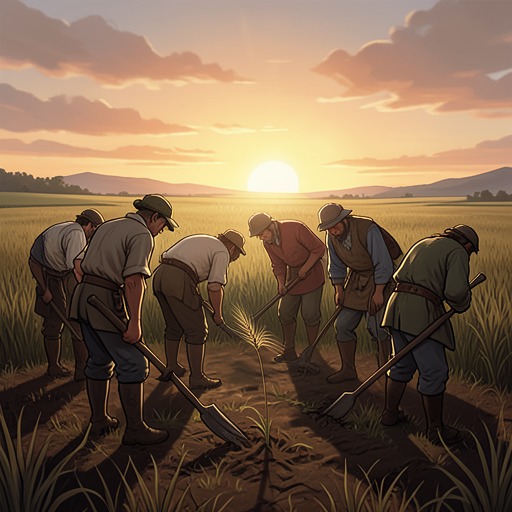
Relief comes when neighboring villagers arrive to help with spring plowing. Under the women’s guidance, the visitors quickly leave for the fields. The previously empty land fills with people, carts, and ploughs; after the first furrows enter the earth, the workers cross themselves and sow. The episode presents agricultural recovery as a shared undertaking, but it also makes visible the women’s organizing role: they guide the work that outside help makes possible. Their labor sustains the community through the crisis, even when they cannot carry the entire burden alone.
Gender, authority, and the limits of endurance
Hanka’s return to farm life gives this labor a personal arc. Looking across the fields, she remembers hunger, hardship, Antek Boryna’s infidelities, and the pain she has endured; what matters to her is that she is back on the farm, on the land, and no longer easily driven away. Her return does not erase the earlier injuries or make the labor costless. Instead, it links endurance to material security and a renewed foothold in the household. The farm is both the site of her work and the condition that allows her to remain there.
The novel also distinguishes women’s productive labor from their constrained social position. Women work, care, organize, and keep households functioning, yet they are judged by standards that men evade. Jagustynka objects to the unequal treatment of women involved in sexual relationships: men may leave their women for years or sow their wild oats without comparable blame, while women bear public condemnation and its consequences. Her protest makes the labor burden part of a broader imbalance: women are expected to preserve family and community life while receiving less latitude, and often less fairness, than men.
The recurring contrast between men’s absence and women’s work is therefore not merely a measure of who is available for farm labor. It shows how the village’s survival depends on work that is easily treated as inexhaustible until crisis exposes its limits. The empty fields, neglected homesteads, and exhausted women register the cost; the neighbors’ ploughing and Hanka’s return show how cooperation and renewed access to land can partly answer it. They do not make the burden equal, but they reveal the labor and practical authority on which Lipce’s continued life rests.